
Introdução
This manual provides essential information for the proper setup, operation, and maintenance of your GODIYMODULES 1969 Class A Power Amplifier Board. Please read these instructions carefully before installation and use to ensure optimal performance and longevity of the product.
Produto acimaview
The GODIYMODULES 1969 Class A Power Amplifier Board is a high-fidelity audio amplifier designed for enthusiasts. It features a robust 2N3055 power amplifier tube and delivers 10-15W of output sound power. This product is supplied as a pair of assembled PCB boards, ready for integration into your audio system.
- Poder Amplifier Tube: 2N3055
- Vol de Trabalhotage: DC 12V-35V (requires a 9-26V transformer with power greater than 100W)
- Output Sound Power: 10-15W
- Dimensões da placa: 100mm x 78mm x 36mm (Angle aluminum with 2 fixed holes, 53mm apart)
- Default Current Setting: 24V, 1.2A (Higher current increases heat output)
- Palestrantes recomendados: 3-5 inch full-range speakers, or 5-8 inch diameter full-range speakers. Speakers with power below 120 watts and below 8 inches are suitable.
- Componentes incluídos: 2 PCS (1 Pair) 1969 Class A Power Ampplacas lificadoras

Figura 1: Angulado view of a single 1969 Class A Power Amplifier Board, showcasing components and heatsink.

Figura 2: Visão de cima para baixo view de dois amplifier boards, highlighting the layout of components and terminals.
Especificações
| Fabricante | MÓDULOS GODIY |
| Número do modelo | 1969 Class A Power Amptábua mais viva |
| Vol. Máximo de Suprimentotage | 35 Volts (CC) |
| Tipo de montagem | Montagem com furo passante |
| Número de canais | 2 |
| Potência de saída | 15 Watts |
| Componentes incluídos | 2pcs (1 Pair) |
Configurar
Careful attention to wiring and power supply is crucial for the safe and effective operation of the ampplacas de lificador.
Requisitos de fornecimento de energia
- O amplifier boards require a DC working voltage entre 12V e 35V.
- An appropriate transformer (9-26V AC output) with a power rating greater than 100W is necessary for the rectifier board.
Conexão do alto-falante
- Connect 3-5 inch full-range speakers for optimal performance.
- Alternatively, speakers with a diameter of 5-8 inches and a power rating below 120 watts are also suitable.
Diagrama de fiação
Refer to the following diagram for proper connection of the amplifier boards to the power supply, rectifier, and speakers.
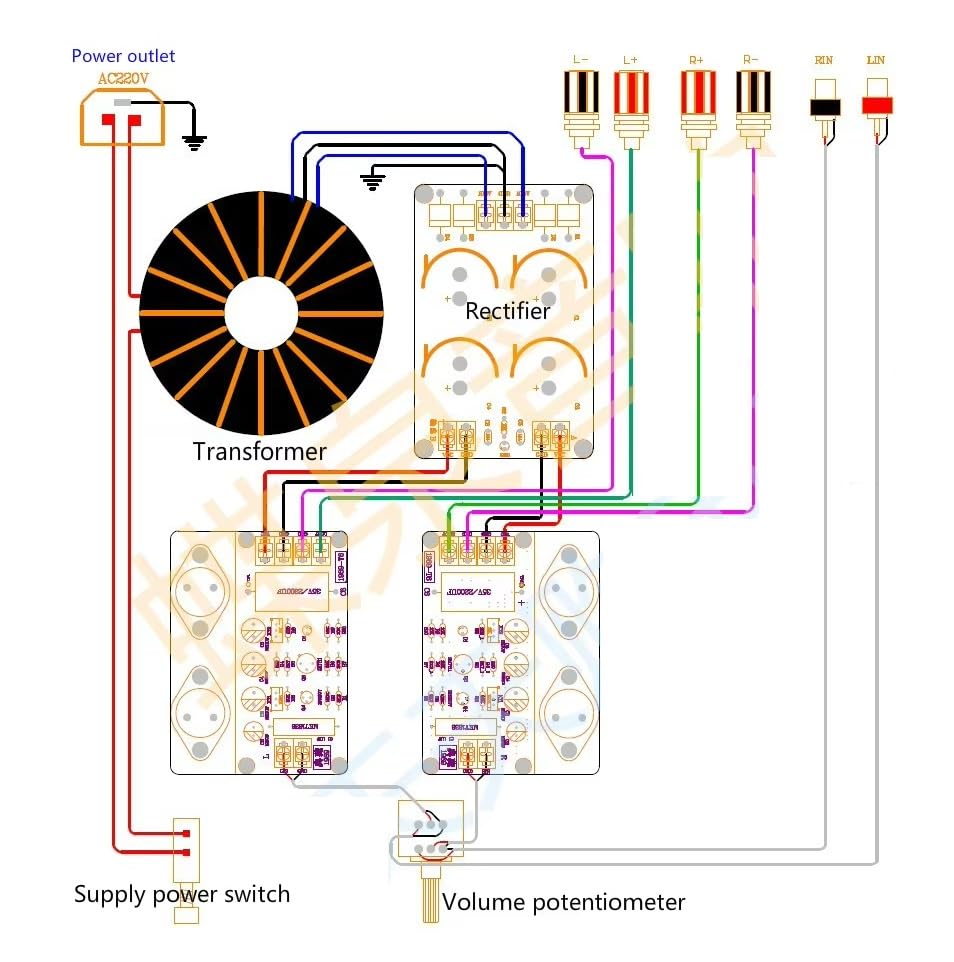
Figure 3: Detailed wiring diagram showing connections from AC power outlet to transformer, rectifier, amplifier boards, and output to speakers and volume potentiometer.
Instruções de operação
Ajuste Atual
It is recommended to adjust the quiescent current for optimal Class A operation. The default setting is 1.2A at 24V.
- Set a universal multimeter to measure current (10-20A range).
- Disconnect the VCC line do poder ampplaca mais viva.
- Connect the red probe of the multimeter to the VCC terminal of the rectifier board.
- Connect the black probe of the multimeter to the VCC terminal of the power amplifier board. This completes the circuit through the multimeter, allowing current measurement.
- Adjust the potentiometer labeled KT2 (W202) on the board to achieve the desired current. A setting of 1.2A is recommended.
- Nota importante: The measurement points for current and midpoint voltage are different. Ensure you change the red probe's connection point when switching between current and midpoint voltage medições.

Figura 4: Detalhe do amplifier board, indicating the location of adjustable components like KT2 (W202) for current adjustment.
Manutenção
To ensure the longevity and stable performance of your amplifier boards, consider the following maintenance guidelines:
- Ventilação: Garanta uma circulação de ar adequada ao redor do amplifier boards, especially given that Class A amplifiers generate significant heat. Do not obstruct the heatsinks.
- Limpeza: Periodically inspect the boards for dust accumulation. Use a soft brush or compressed air to gently remove dust from components and heatsinks.
- Conexões: Regularly check all wiring connections to ensure they are secure and free from corrosion. Loose connections can lead to intermittent performance or damage.
- Condições ambientais: Operar o amplifier in a dry environment, away from excessive humidity, direct sunlight, and extreme temperatures.
Solução de problemas
Se você encontrar problemas com seu amplifier boards, review Os seguintes problemas comuns e suas soluções:
- Sem saída de som:
- Verify all power connections are secure and the power supply is providing the correct voltage.
- Verifique se as conexões das caixas de som estão com a polaridade correta e se o contato está firme.
- Ensure the audio input source is functioning correctly.
- Som distorcido:
- Check the input signal level; excessive input can cause distortion.
- Ensure speakers are correctly matched to the amplifier's output power and impedance.
- Verify the current adjustment (KT2/W202) is set correctly (e.g., 1.2A).
- Calor excessivo:
- Classe A amplifiers naturally run hot. However, ensure adequate ventilation and heatsink clearance.
- Check the quiescent current setting; a higher current will generate more heat.
- High Frequency Ringing (>12kHz):
- Some users have reported that adding a 500pF capacitor in parallel with resistor R5 can help mitigate high-frequency ringing. This modification should only be performed by experienced individuals.
Informações de garantia
Specific warranty details for this product are typically provided at the point of purchase or by the seller. Please refer to your purchase documentation or contact your retailer for information regarding warranty coverage and terms.
Apoiar
For technical assistance, troubleshooting beyond this manual, or inquiries regarding your GODIYMODULES 1969 Class A Power Amplifier Board, please contact the seller or manufacturer directly through the platform where the product was purchased. Provide your order details and a clear description of the issue for efficient support.